 成片拆解
成片拆解1第 1 步
九宫格分镜 · ① GPT Image 2.5 提示词
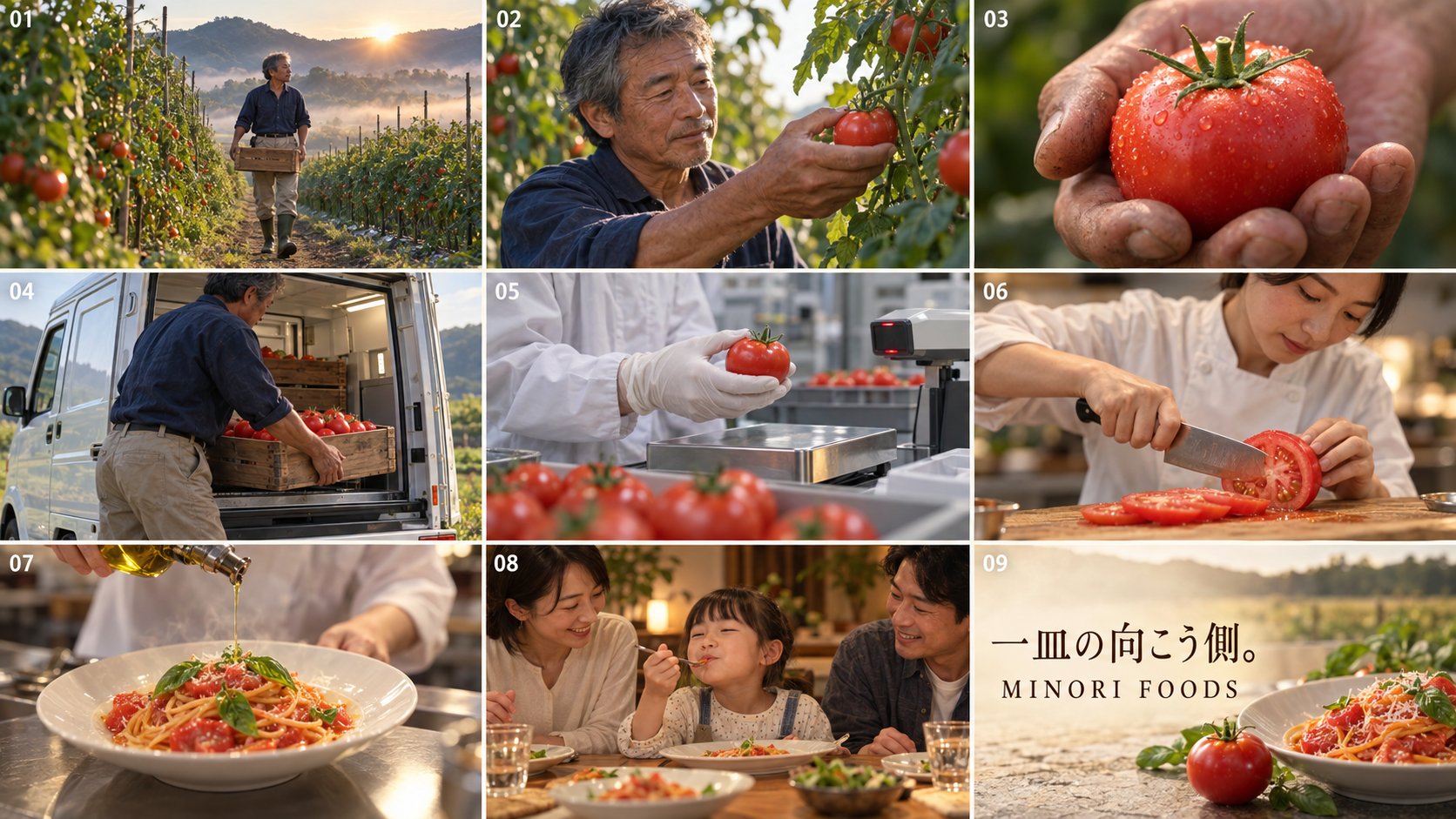
作者原图 1672×941 · 3×3 镜头 01–09
▸查看完整出图提示词(点击复制区)
复制
Create a production-ready photo storyboard for a 10-second corporate commercial for the fictional Japanese food and agriculture company “MINORI FOODS.”

CONCEPT

The central message is “Beyond Every Plate.”

Follow one perfectly ripe red tomato as a visual baton connecting a farmer’s harvest, refrigerated transportation, quality inspection, professional cooking and a family dinner table.

The commercial should communicate that one meal is made possible by the care and craftsmanship of many people, from the producer to the consumer.

STORYBOARD FORMAT

Create one landscape 16:9 image containing exactly nine storyboard panels.

Arrange the panels in a perfectly even 3-column × 3-row grid. Each individual panel must be composed as a cinematic horizontal 16:9 frame.

Use thin ivory-colored gutters between the panels.

Place small white panel numbers “01” through “09” in the upper-left corner of each panel, ordered from left to right, top row to bottom row.

Do not include captions, arrows, production notes, watermarks or additional logos.

Every panel must look like a high-quality photographic frame extracted from the same finished live-action commercial—not nine unrelated stock photographs.

VISUAL WORLD

The commercial begins at a quiet tomato farm in rural Japan, moves through a clean food quality-control facility and a professional restaurant kitchen, and ends at a warm contemporary family dining table.

Time progresses naturally from cool early-morning light to warm evening light.

The same ripe red tomato serves as the visual thread throughout the sequence.

Use a restrained color palette of natural leaf green, rich tomato red, earthy brown, stainless-steel silver, warm wood and clean off-white.

CHARACTER CONTINUITY

Farmer:

A Japanese man approximately 58 years old. He has a naturally sun-weathered face, short salt-and-pepper hair and a calm, sincere expression.

He wears the same dark indigo work shirt, beige work trousers and olive-green rubber boots in every relevant panel.

His face, hairstyle, body proportions, hands and clothing must remain consistent. He should look like a real working farmer rather than a fashion model.

Chef:

A Japanese woman approximately 34 years old. She has a natural, approachable face, minimal makeup and straight black hair tied in a neat low ponytail.

She wears the same clean white chef jacket in every kitchen scene. Preserve her face, hairstyle, physique and wardrobe.

Family:

A Japanese couple in their 30s and their elementary-school-age daughter. They live in a contemporary but warm and realistic home.

Their expressions should be subtle and natural, without exaggerated advertising smiles.

NINE STORYBOARD PANELS

01 — DAWN AT THE FARM

A wide environmental shot of a Japanese tomato farm at dawn.

Long rows of tomato plants extend toward distant low mountains. The low morning sun shines through the leaves, and a light mist remains between the rows.

The farmer walks toward the camera carrying an empty wooden harvest crate.

Use a cinematic wide composition that establishes the location and atmosphere.

02 — HARVEST

A medium close-up of the same farmer gently twisting one ripe red tomato from the vine.

Show his calm, focused expression, realistic leaves and warm backlight outlining his hands and face.

The image should capture one simple, precise harvesting action.

03 — THE TOMATO

An extreme macro photograph of the freshly harvested tomato resting in the farmer’s open palm.

Render tiny dew droplets, natural skin texture, subtle imperfections, the green calyx and the authentic texture of his working hands.

The tomato must look fresh, moist and completely photorealistic—not glossy plastic.

04 — REFRIGERATED DELIVERY

A low-angle close shot beside a small white refrigerated delivery van.

The farmer places a wooden crate filled with matching ripe tomatoes into the clean cargo area.

Show one controlled lifting-and-placing action. Do not display any existing company logos or vehicle branding.

05 — QUALITY CONTROL

Inside a modern and hygienic food quality-control facility.

White-gloved hands carefully inspect and weigh one tomato on a stainless-steel workstation. Include a realistic digital scale, a small lot-label scanner and clean food-processing equipment.

The scene should feel credible, practical and sanitary—not futuristic or science-fictional.

06 — PREPARATION

A close-up inside a professional restaurant kitchen.

The same female chef slices the tomato on a wooden cutting board using a stainless-steel chef’s knife.

Render the tomato flesh, seeds, moisture, juice and metal reflections precisely.

Her hands and fingers must be anatomically correct and positioned safely.

07 — PLATING

A top-down overhead food composition.

The chef finishes a simple, elegant tomato pasta dish with fresh basil and pours one thin stream of olive oil over the plate.

Show gentle steam, moist tomato pieces, the sheen of olive oil and refined but realistic restaurant presentation.

08 — THE DINNER TABLE

An intimate medium shot at a warm family dinner table.

The young daughter takes her first bite of the tomato pasta while her parents watch and smile naturally.

The plated tomato dish should remain clearly visible.

Capture a genuine moment of quiet happiness rather than an exaggerated commercial performance.

09 — FINAL BRAND FRAME

A premium food-advertising hero shot on a textured stone tabletop.

Place the finished tomato pasta, one whole ripe tomato and a few fresh green leaves on the right side of the frame.

Use a softly blurred evening farm landscape in the background.

Reserve generous clean negative space on the left side.

In the left-side negative space, display only the following exact text:

“一皿の向こう側。”

Below it:

“MINORI FOODS”

Use refined dark-brown Japanese Mincho-style typography for the Japanese copy and an elegant serif typeface for the company name.

Do not add any other words, claims or logos.

PHOTOGRAPHY AND LIGHTING

Ultra-photorealistic premium Japanese food advertising with warm documentary realism.

Use realistic 35mm and 50mm lens perspectives for people and locations, and a 90mm macro-lens look for the tomato, food and hands.

Use shallow depth of field where appropriate, smooth highlight roll-off and deep but readable shadows.

Lighting should progress naturally from fresh golden morning light at the farm to clean neutral light in the quality-control facility and warm evening light in the kitchen and home.

Preserve natural skin texture, fine food moisture, leaf veins, soil, wood grain, stainless steel and fabric detail.

Add subtle cinematic film grain.

Keep the color grading restrained and sophisticated.

CONTINUITY REQUIREMENTS

All nine panels must belong to the same visual story.

Maintain consistent character identities, clothing, tomato appearance, locations, lighting direction and photographic style.

Create visual rhythm by alternating wide shots, medium shots, macro details, process shots, overhead food photography, an emotional reaction and a final product hero frame.

Each panel should contain only one clearly readable action.

AVOID

Malformed hands or fingers, extra limbs, duplicated or fused tomatoes, inconsistent faces, changing wardrobe, plastic-looking food, excessive saturation, heavy orange color grading, artificial CGI glow, fantasy effects, unhygienic food handling, unsafe knife positions, futuristic holograms, object morphing, split screens inside individual panels, unwanted text, extra logos and watermarks.