SCENE CONTEXT
A 30-second morning self-shot vlog inside Cinderella’s attic bedroom. One young woman wakes beside her calico cat, welcomes the morning at the window, dresses for the day and introduces her companion to the viewer. Twelve shots connected by instantaneous HARD CUTS.

ACTIVE REFERENCES
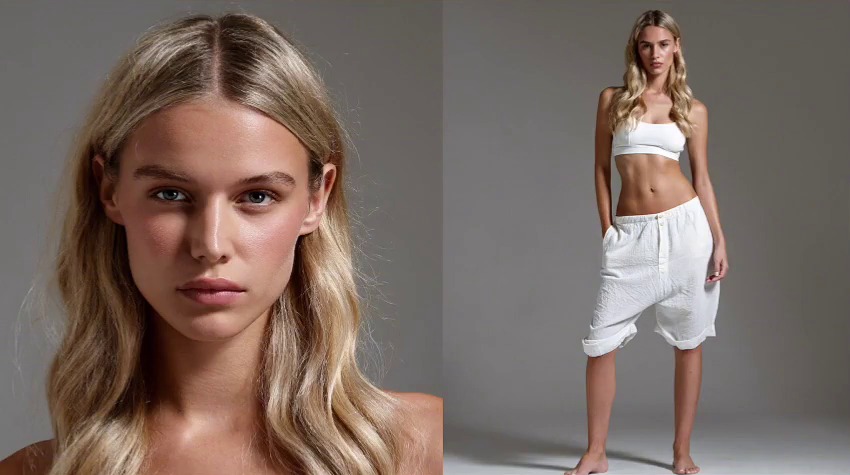
@image1 defines the exact adult woman, age 20: face, eyes, natural blonde hair, tall proportions, narrow waist and white starting outfit. Preserve her reference appearance.
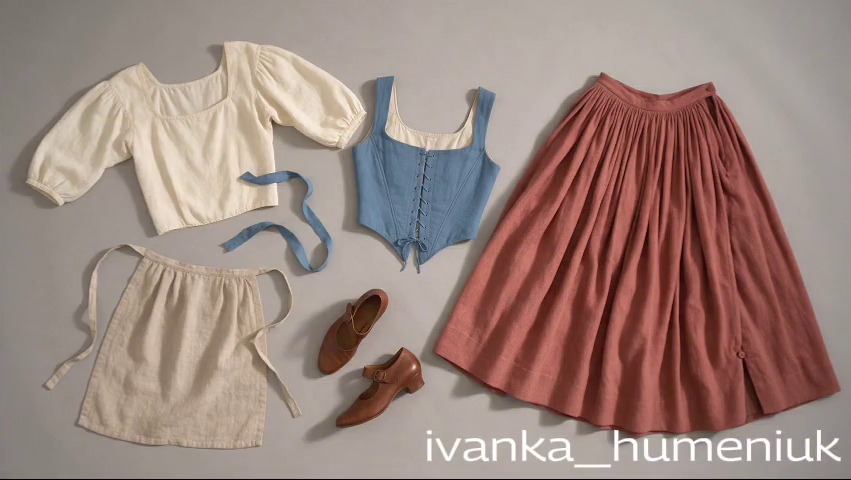
@image2 defines every final wardrobe item: ivory blouse, dusty-blue lace-front bodice, terracotta skirt, oatmeal apron, brown buckle shoes and blue hair ribbon.
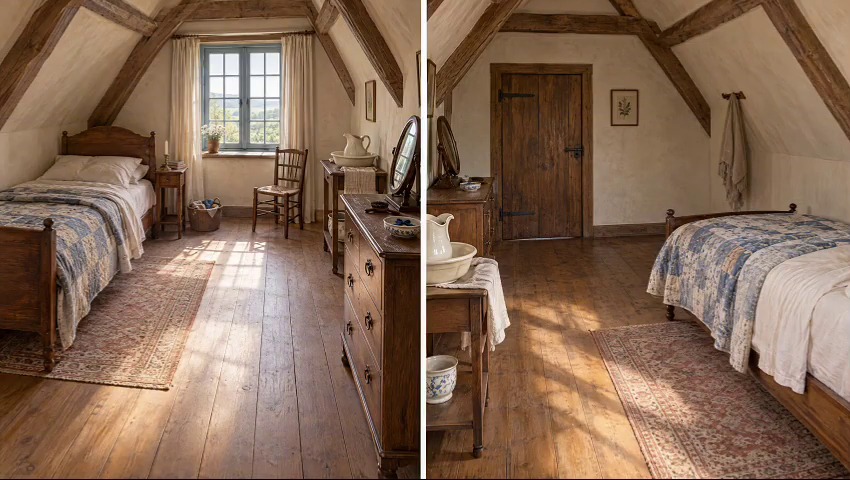
@image3 contains two opposite views of ONE bedroom with ONE bed. Its left panel supplies the fixed dressing composition. Its right panel explains the reverse architecture of this same room.
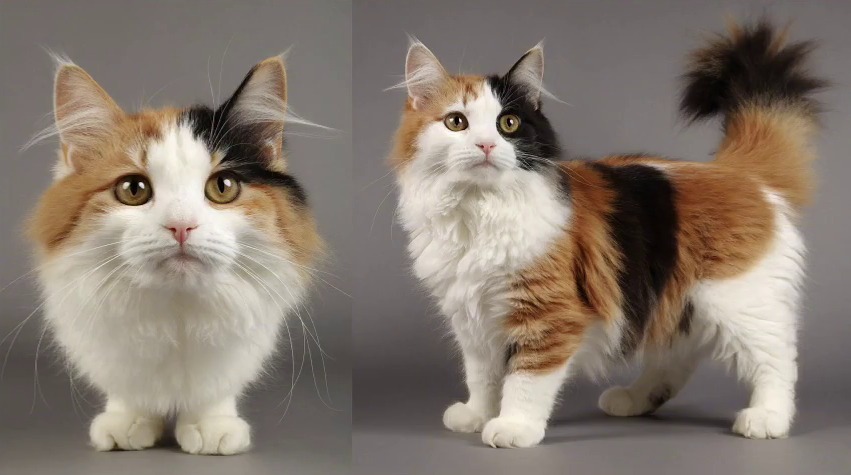
@image4 defines the exact fluffy calico cat, amber eyes, face markings, body patches and tail colour. Preserve the photographed patch map.

LOCATION MAP
Exactly one bed occupies the wall on the left when looking from the entrance toward the window. Its headboard stands near the window and its foot points toward the entrance. The dresser and washstand occupy the opposite wall on the right. The entrance is behind the dressing camera. Preserve the reference chair, basket, mirror, rug and bedside table.

The room’s right-hand side contains the dresser and washstand throughout. Every interaction with the bed takes place at the single bed on the left.

At the beginning, the folded outfit rests on the chair, the shoes stand together beneath it, and the ribbon lies in the dresser dish. The cat rests on the quilt beside the woman’s waist. The central floor remains clear for dressing.

CAMERA AND EDITING
Shots 1–11 are self-placed resting-camera views, completely stationary throughout each shot. The early bedside and window setups change only through the specified HARD CUTS.

DRESSING MASTER, SHOTS 5–11:
One camera rests near the entrance at a height of 1.2 metres, facing toward the window with a fixed 47° field of view. Match the left panel of @image3: single bed on screen-left, blue window at the rear centre, dresser at screen-right, washstand farther back on screen-right. The dresser edge remains a visible foreground anchor.

Treat shots 5–11 as excerpts from ONE uninterrupted tripod recording, shortened by jump cuts. The background is the same registered image across all seven shots: identical window size and position, identical bedpost alignment, identical dresser edge and ceiling beams. Position, height, lens, direction, focus setting and exposure remain fixed. Framing changes solely through the woman physically approaching or retreating from this stationary lens. Her complete head remains visible when she approaches.

Shot 12 is the sole handheld selfie, at 84° field of view. Her extended arm motivates its slight natural movement. Recording equipment stays outside the captured frame and outside mirror reflections throughout. The mirror reflects the opposite wall.

Every transition is an instantaneous HARD CUT at the stated time. Wardrobe changes take place in omitted time between shots. Each visible action runs at natural human speed.

ACTION

0.0–3.0 seconds — SHOT 1, 47°, STATIC SIDE VIEW.
Resting camera beside the single bed at mattress height, a soft quilt edge in the near foreground. She lies on her side facing the camera, head on the pillow, wearing the white cropped top and knee-length white bottoms from @image1. The calico rests beside her waist. She opens her eyes, looks down at the cat and gently scratches its cheek with two fingers. The cat leans into her touch; a small closed-lip smile appears.

3.0 seconds — HARD CUT.

3.0–4.5 seconds — SHOT 2, 29°, STATIC LOW DETAIL.
Resting camera near floor level beside the same bed, wooden bedpost at the frame edge. She is already seated on the mattress edge. Her bare lower legs descend together, and both feet settle naturally onto the rug. The white knee-length bottoms remain visible. The mattress compresses beneath her weight.

4.5 seconds — HARD CUT.

4.5–7.0 seconds — SHOT 3, 47°, STATIC INTERIOR WINDOW VIEW.
Resting camera on the dresser INSIDE the bedroom, looking diagonally toward the window. The dresser edge is visible in the near foreground. She stands entirely INSIDE the room, both feet on the bedroom floor, between the camera and the window. Her back and right shoulder face the camera in three-quarter view; her face looks toward the glass and countryside.

Still wearing her white starting outfit, she stands beside the opening path of the right-hand casement as viewed from inside. She turns its interior latch with her right hand, steps slightly backward and draws the handle toward herself. The leaf rotates inward around hinges fixed to the right jamb. Her body remains on the room side of the sill throughout. The other casement stays closed, and the flowerpot remains at the left end of the sill. She finishes with the opened leaf held beside her inside the room.

7.0 seconds — HARD CUT.

7.0–9.0 seconds — SHOT 4, EXACT SAME STATIC INTERIOR WINDOW VIEW.
The right-hand casement is already open inward. She stands one step back from the sill, clear of the opened leaf, still seen from behind in three-quarter view. Facing the morning outside, she raises both arms overhead in one comfortable stretch, lifts her chest with an inhale and begins lowering her arms. A light breeze stirs her hair ends and the curtain edge.

9.0 seconds — HARD CUT.

9.0–11.0 seconds — SHOT 5, FIXED DRESSING MASTER, 47°.
Establish the master composition that remains identical through shot 11: window at rear centre, single bed left, dresser right. Her complete standing figure fits inside the frame. She still wears the white starting outfit and already holds the ivory blouse by its shoulder seams. She presents its front against her torso, glances at the fabric, then meets the lens with a small pleased smile. The remaining garments stay on the chair.

11.0 seconds — HARD CUT.

11.0–13.0 seconds — SHOT 6, SAME DRESSING MASTER.
The background stays exactly registered to shot 5. The ivory blouse and terracotta skirt are now fully worn, blouse tucked neatly into the skirt’s natural-waist waistband. She is barefoot. She smooths the waistband with her palms, then shifts her weight lightly; the skirt settles in broad folds. Her white base layers remain beneath the outfit.

13.0 seconds — HARD CUT.

13.0–15.5 seconds — SHOT 7, SAME DRESSING MASTER.
The background keeps the same scale, direction and alignment. The dusty-blue bodice is now worn over the blouse, its front lacing already threaded and tied. She has moved closer to the stationary lens, bringing her entire head and torso into a larger view while the window remains behind her. Looking down, she gives the two finished bow loops one small tightening tug, then releases them. Her face lifts toward the viewer.

15.5 seconds — HARD CUT.

15.5–18.0 seconds — SHOT 8, SAME DRESSING MASTER.
She has stepped back into complete head-to-foot view within the unchanged composition. The oatmeal apron is now tied over the skirt and both brown shoes are on her feet. Her hair is half-up, secured with the blue ribbon, while the remaining blonde lengths hang loose. In a relaxed three-quarter stance she smooths the apron once, then turns toward the lens.

18.0 seconds — HARD CUT.

18.0–21.0 seconds — SHOT 9, SAME DRESSING MASTER.
She stands in the full finished outfit at the same distant mark. She lightly takes the skirt at its sides, makes a small quarter-turn to show its volume, then faces forward and releases the fabric. The skirt swings after her body and settles. She gives the viewer a warm closed-lip smile, then looks toward the single bed on screen-left.

21.0 seconds — HARD CUT.

21.0–25.0 seconds — SHOT 10, SAME DRESSING MASTER.
She is already securely holding the calico against her torso, one forearm supporting its hindquarters and the other supporting its chest. From the middle of the room she takes two short steps toward the stationary camera, bringing their faces closer together in the frame. The window remains behind her; the bed and dresser stay at their established screen positions. She looks affectionately at the cat, then at the lens. The cat watches the viewer, ears relaxed, paws resting naturally over her supporting arm.

25.0 seconds — HARD CUT.

25.0–27.0 seconds — SHOT 11, SAME DRESSING MASTER.
The full master composition remains fixed. She is beside the SINGLE BED ON SCREEN-LEFT, bending with the cat supported just above its blue quilt. She lowers it the final short distance. Its paws contact the bedding before her hands release; it settles onto the quilt as she straightens. The dresser and washstand remain on screen-right.

27.0 seconds — HARD CUT.

27.0–30.0 seconds — SHOT 12, 84°, HANDHELD SELFIE.
She stands beside the same bed in her complete outfit, holding the viewpoint at arm’s length slightly above eye level. Her extended forearm enters the lower corner; her face stays near the image centre. The calico sits visibly on the single bed behind her shoulder. She glances back at it, returns her gaze to the lens and smiles with closed lips. A small natural wrist adjustment and breathing create the only camera movement in the sequence. End on her relaxed smile as the cat gives a slow blink.

PERFORMANCE
A real living woman with visible pores, delicate facial hairs, natural lip texture and fine variations in skin colour. Individual blonde strands catch the window light. Natural blinking, breathing and gaze changes. Her sleepy expression gradually becomes alert and quietly cheerful. The cat behaves like a real animal, with small ear adjustments, whisker movement and subtle breathing.

PHYSICS
Linen bends into weighty folds; the skirt follows turns with a slight delay. Hands make clear contact with fabric and the window handle. Feet bear weight against the floor. The cat’s body remains supported during carrying, its fur compressing naturally against her forearms. Bedding depresses beneath paws and body weight.

LIGHTING
One continuous bright morning. Daylight enters through the reference window, with warm reflected light from the wooden floor and soft fill from ivory plaster. Stable exposure and 5300K white balance. Opening the casement introduces a light breeze while maintaining consistent illumination.

COLOR GRADE AND FILM TEXTURE
The entire sequence resembles a well-preserved colour theatrical film print from the 1950s. Three-strip Technicolor-inspired dye density: deep cornflower-blue fabric, rich copper-terracotta skirt, warm cream linen and honey-amber wood. Skin retains natural peach and rose variation within the period colour palette.

Clearly visible fine-to-medium 35mm photochemical grain dances independently from frame to frame across skin, walls, fabrics and shadows. Gentle optical softness blends high-contrast edges while facial features remain readable. Bright window highlights carry restrained warm halation; illuminated linen has a soft luminous bloom. Dense coloured shadows retain texture, and highlights roll into creamy film white. The same film-print response covers every shot, including the selfie. The grain moves while the photographed room remains spatially steady.

AUDIO
A light playful instrumental with pizzicato strings and soft woodwind runs quietly beneath the entire sequence. Audible bedding rustle, gentle purring, bare feet touching the rug, window-latch click, hinge creak, morning birds, clothing rustle and soft shoe taps. The final close moment carries a quiet contented breath and the cat’s purr. Instrumental music and natural location sounds form the complete soundtrack.

STYLE AND OUTPUT
30 seconds, 16:9 horizontal, full-frame live-action imagery, 1950s colour-film finish and visible organic grain. Self-shot intimacy within a period-film world. Real-time movement within each shot.

POSITIVE LOCKS
One woman, one calico cat, one bedroom, exactly one bed. The two room-reference panels represent opposing views of that single room. Reference identity and cat markings stay consistent.

The woman opens the window from inside, seen from behind in three-quarter view. The right casement stays open after shot 3.

Shots 5–11 use one identical locked camera composition facing the window. The woman moves within that composition; background landmarks retain their exact positions and sizes across cuts.

Completed wardrobe layers remain worn in subsequent shots; the blue ribbon stays secured from shot 8 onward. The finished video presents one full-screen scene at a time.
 成片拆解
成片拆解